
Demo: Attention, Without the Jargon
A sample explainer showing how attention lets a model weigh context. Labeled sample content — not a published report.
Demo article. Sample content for layout review. It is not published reporting and does not describe real events.
This is a labeled demo article. It exists to verify the Markdown publishing pipeline end to end: headings, lists, links, quotes, code, tables, and images. It is not published reporting and does not describe real events, real studies, or real research findings.
Why this demo exists
SiliconPost article pages are generated from Markdown files in src/content/articles/. The filename
becomes the URL slug, so this entry is served at /articles/demo-attention-without-the-jargon/.
What it verifies
- Automatic heading anchors and the on-page table of contents
- Ordered and unordered lists
- Internal links between article pages
- Blockquotes, inline code, and fenced code blocks
- Local images and GFM tables
Scope note
Nothing in this document is a claim about how attention actually works. It is placeholder copy written to exercise the renderer.
A short example
- Add a Markdown file to
src/content/articles/. - Add valid frontmatter.
- Run
npm run build. - Astro generates the page and lists it in the homepage sections.
The starting point for a new article is
src/content/articles/_template.md. Copy it, keep the frontmatter predictable, and publish only when the copy is ready.
npm run buildRelated sample: Demo: When to Use a Vector Index.
Supported building blocks
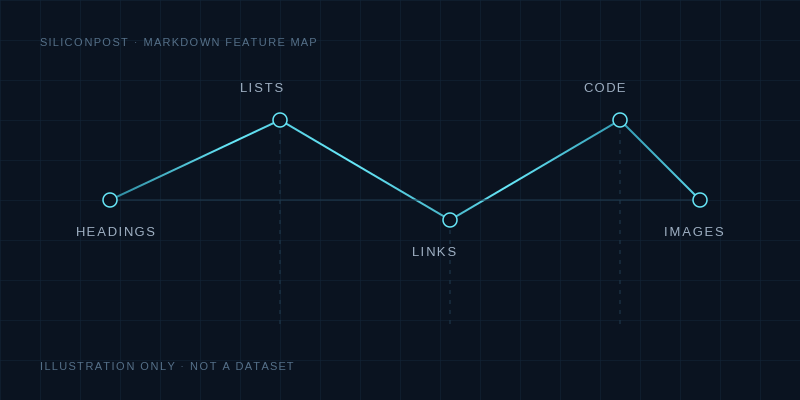
| Feature | Status | Notes |
|---|---|---|
| Headings | Supported | H1–H4 with automatic anchors |
| Lists | Supported | Ordered and unordered |
| Code | Supported | Inline and fenced blocks |
| Images | Supported | Local files stored in public/ |
What a real article would add
A finished explainer would replace this copy with reported material, keep the frontmatter
predictable for automated generation, and leave draft: true until an editor is ready to publish.